The Milling Machine: A Silent Architect of Modern Manufacturing
In the vast landscape of manufacturing technologies, few machines possess the quiet authority and enduring relevance of the milling machine. Often overshadowed by flashier innovations like 3D printing or advanced robotics, the milling machine remains a cornerstone of precision engineering—an adaptable workhorse that shapes the world in ways most people never notice.
From the contours of airplane wings to the gear teeth in your car’s transmission, milling machines help construct the backbone of modern civilization. Their evolution mirrors humanity’s own journey toward precision, efficiency, and automation.
A Brief Evolution: From Manual Craft to Digital Mastery
The milling machine’s origins trace back to the 18th century when artisans needed a more reliable way to shape metal than by hand tools. Early designs were simple: rotating cutters mounted on crude frames. But the Industrial Revolution accelerated development, pushing engineers to build sturdier machines capable of repeatable accuracy.
The true transformation came in the 20th century with the introduction of numerical control (NC) and later computer numerical control (CNC). CNC technology allowed milling machines to follow digitally programmed paths, opening the doors to ultra-complex geometries and mass production without sacrificing precision.
Today’s CNC mills integrate automation, sensors, simulation software, and sometimes even AI-driven toolpath optimization. What began as a manual craft is now an ecosystem of smart manufacturing.
What Makes a Milling Machine Unique?
A milling machine removes material by feeding a workpiece against a rotating cutter. While that sounds simple, the versatility is extraordinary. Unlike lathes, which primarily work with cylindrical parts, milling machines manipulate almost any shape imaginable.
Key Elements That Define Its Functionality
Rotary Cutting Tools: End mills, face mills, ball cutters, and shell mills each create distinct profiles.
Multi-Axis Movement: Standard mills operate on 3 axes (X, Y, Z), while advanced CNC versions extend to 4, 5, or even 7 axes, enabling sculpting-like precision.
Rigid Framework: Stability is essential. Heavy cast-iron frames minimize vibration and maintain accuracy.
Adjustable Spindle Speeds: Allow machining of diverse materials—from aluminum to hardened steel to plastics.
This combination of flexibility and rigidity makes the milling machine one of the most adaptable tools in manufacturing.
Types of Milling Machines: A World of Capabilities
1. Vertical Milling Machine
The most common type. The spindle is vertical, making it ideal for slotting, cutting, and surface milling. Its simplicity and visibility make it popular in workshops.
2. Horizontal Milling Machine
The spindle lies horizontally, which gives superior torque and stability when cutting heavier materials. Ideal for large production runs or deep cuts.
3. Universal Milling Machine
A hybrid system that allows both vertical and horizontal milling, offering unmatched flexibility in smaller shops.
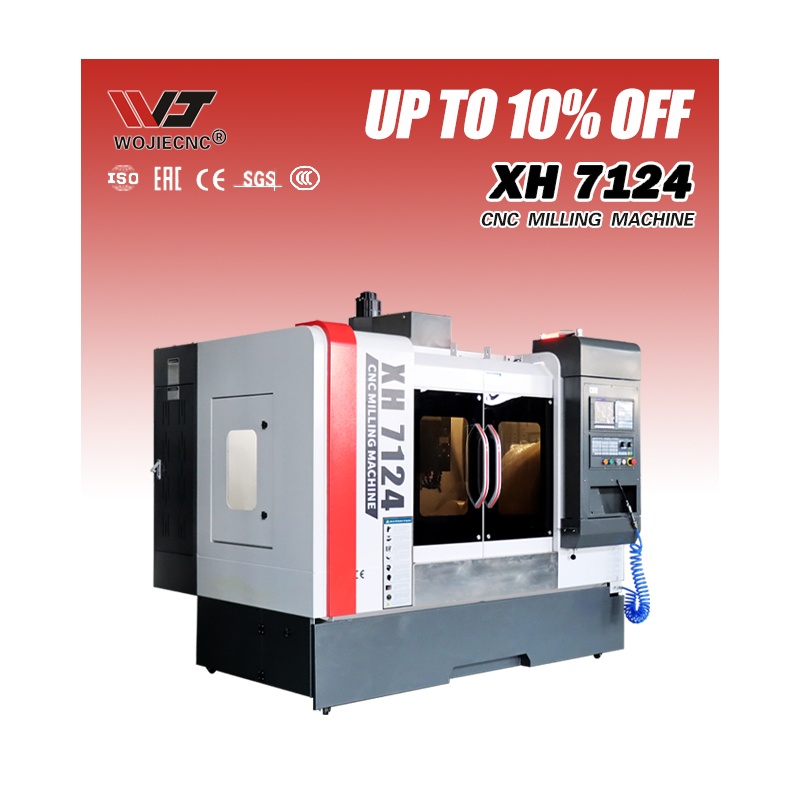
4. CNC Milling Machine
Digitally controlled for precision and repeatability. CNC mills can machine intricate shapes impossible to achieve manually.
5. Gantry/Bridge Mills
Large-scale machines used for aerospace, shipbuilding, and the machining of oversized components.
6. Turret and Bed Mills
Designed for workshops and prototyping. Turret mills allow the spindle to move, while bed mills keep the table fixed for heavier machining.
How Milling Machines Shape the Modern World
Milling machines are more than metal-cutting devices—they’re enablers of innovation. Their influence stretches across industries:
● Aerospace
From turbine blades to airframe components, 5-axis milling ensures aerodynamic precision.
● Automotive
Engines, gearboxes, brake components—milling machines are responsible for the accuracy that vehicles rely on.
● Medical
Surgical instruments, bone plates, dental implants, and custom prosthetics are all milled with micrometer-level accuracy.
● Electronics
Heat sinks, circuit housings, and aluminum chassis for computers all start on milling machines.
● Energy Sector
Wind turbine hubs, electric motor components, and drilling equipment rely heavily on large-scale CNC milling.
Every industry with a need for shaped materials has a silent partnership with milling technology.
Emerging Trends: The Future of Milling
1. AI-Driven Toolpath Optimization
Machine learning algorithms are beginning to predict optimal cutting strategies, reducing wear and improving precision.
2. Hybrid Manufacturing
Machines that combine CNC milling with additive manufacturing (3D printing) allow for unprecedented design flexibility.
3. Autonomous Machining Cells
Robotic arms load and unload parts, enabling 24/7 lights-out production.
4. Eco-Friendly Cutting Technologies
Coolant-less machining, advanced lubrication systems, and energy-efficient motors are reducing environmental impact.
5. Digital Twins
Virtual replicas simulate milling operations before the first physical cut, saving time and resources.
Why Milling Machines Continue to Matter
Despite the rise of additive manufacturing, milling machines remain indispensable. They offer:
Unmatched precision
Superior surface finish
Versatility across materials
Reliability in mass production
While 3D printing builds, milling refines. The two technologies are complementary, not competitive.
In essence, milling machines are the quiet custodians of precision engineering. They enable the industries that modern life depends on, and their evolution continues to shape the future of manufacturing.