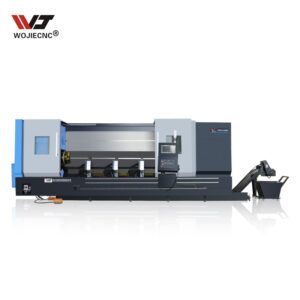
A VMC machining center is a vertical-spindle CNC mill with an automatic tool changer, and the specification that decides whether it holds tolerance is not the spindle speed — it is the combination of work envelope, guideway type, positioning accuracy and the acceptance test behind those numbers.
Read a VMC spec sheet in this order: (1) table size and X/Y/Z travels against your largest part; (2) spindle taper and speed range against your material; (3) guideway type against your cut severity; (4) positioning accuracy and the standard it was measured to; (5) tool magazine capacity against your operation count. Everything else — control brand, chip conveyor, probe — is configuration.
This guide explains what each line means, shows a worked example on a real spec sheet, and lists the five contractual checks to run before you place a deposit.
What a VMC Is — and When It Is the Wrong Machine
A vertical machining center holds the workpiece on a horizontal table and brings a vertical spindle down onto it, swapping tools automatically from a magazine. That architecture suits prismatic parts: plates, housings, brackets, moulds, cams, and anything where the dominant machining direction is from above.
It is the wrong machine in three situations:
- The part is a shaft or a disc. Turning is more efficient; a lathe rotates the work instead of interpolating around it.
- The part is a large box requiring machining on four or five faces. A horizontal machining center (HMC) indexes the part on a rotary table and keeps the spindle horizontal, which removes the need for tall Z travel and long tools.
- The part is small, flat and simple, in low volume. A 3-axis CNC mill without a tool changer costs less and may be sufficient.
The VMC’s real advantage is setup consolidation: drilling, milling, boring, reaming and rigid tapping in one clamping, which is where the accuracy actually comes from — every re-fixturing is an opportunity to lose it.
The 9 Specifications That Decide Accuracy
| # | Spec line | What to read | Why it matters |
|---|---|---|---|
| 1 | Table size & load | Table dimensions and max workpiece weight | Determines whether your fixture and part fit at all |
| 2 | X/Y/Z travels | Travel beyond table size, not equal to it | The part must fit and the tool must reach every feature |
| 3 | Spindle taper | BT40 / CAT40 / HSK-A63 | Defines tooling ecosystem, rigidity and achievable speed |
| 4 | Spindle speed range | Max rpm plus power and torque curve | Aluminium wants rpm; steel wants torque at low rpm |
| 5 | Guideway type | Linear rail vs box way, and roller vs ball | Sets the speed/rigidity trade-off (see next section) |
| 6 | Positioning accuracy | Value and measurement standard | A number without a standard is marketing |
| 7 | Repeatability | Bi-directional repeatability | Matters more than accuracy for production consistency |
| 8 | Tool magazine | Station count, tool diameter and weight limits | Limits how many operations you can run unattended |
| 9 | Machine mass | Net weight and casting construction | Mass absorbs vibration; light machines chatter under load |
Two of these are routinely misread. Travels are not table size — a 800 × 320 mm table does not mean 800 mm of X travel, and the difference is what stops you machining the ends of a long part. And positioning accuracy without its test standard is unfalsifiable; ±0.0075 mm measured to a stated standard is a specification, the same number with no standard is a claim.
Box Way vs Linear Guideway: The Choice That Defines the Machine
This is the decision buyers argue about most, and the argument is usually framed wrong.
Kent CNC describes the two mechanisms plainly. Box ways are “a pair of precision ground metal surfaces with a thin film of lubricating oil between them”, usually with a Turcite layer and hand-scraped oil pockets. Linear guideways work “similar to roller or needle bearings, but made flat” — bearing trucks running on rails bolted to the casting (Kent CNC).
The practical consequences, in Kent’s own framing:
| Linear guideway | Box way | |
|---|---|---|
| Traverse speed | Higher — “often two to three times faster” | Lower |
| Stick-slip | Minimal, so generally considered more accurate | Present; the reason hand-scraped box ways still dominate “mother machines” |
| Load capacity | Good; better still with roller rather than ball bearings | Higher |
| Heavy or interrupted cuts | Adequate on a properly designed heavy-duty linear machine | Preferred; better chatter resistance |
| Best fit | Production work, high-speed cycles, aluminium | Heavy cutting, hard materials, deep cuts |
Kent’s conclusion is the one worth quoting to any supplier: “what’s most important in any machine tool is its overall quality rather than any specific technology.” A well-built linear VMC outperforms a badly built box-way machine, and vice versa. The guideway type tells you which trade-off the builder optimised for — not how well they executed it.
Worked Example: Reading a Real Spec Sheet
Abstract advice is easy. Here is how the nine lines read on an actual entry-level VMC spec sheet — the VMC640 — so you can see what “specific” looks like.
| Spec | Value | What it tells a buyer |
|---|---|---|
| Table size | 800 × 320 mm | Fits small plates, housings, mould inserts |
| Travels | X 600 / Y 360 / Z 450 mm | Note X travel is 200 mm less than table length — plan fixture offsets |
| Max table load | 300 kg | Rules out heavy die work |
| Spindle | BT40, max 10,000 rpm, 5.5 kW | BT40 tooling ecosystem; rpm suits aluminium and light steel |
| Guideway | Linear rail, all three axes | Speed-oriented; not a heavy interrupted-cut machine |
| Positioning accuracy | ±0.0075 mm | Meaningful if measured to a stated standard — ask which |
| Rapid traverse | 24/24/20 m/min (optional 48/48/36) | The option roughly doubles non-cutting speed |
| Tool magazine | 16 stations hat type, optional 24 arm | 16 covers simple parts; 24 arm for multi-operation work |
| Tool limits | φ90 mm, 8 kg | Constrains face-mill and boring-bar size |
| Machine weight | 3,000 kg | Entry-class mass — expect lower chatter threshold than a 6-tonne machine |
Read that way, the sheet tells you what the machine is for: small-to-medium prismatic parts, aluminium and light steel, production runs where rapid traverse matters, with a 4th-axis rotary table available as an option. It also tells you what it is not for: heavy dies, deep interrupted cuts in hardened steel, or parts needing more than 16 tools.
That is the level of reading to apply to every quote you receive. A spec sheet you cannot interpret this way is a spec sheet you cannot compare.
VMC vs HMC: Which Configuration Fits Your Parts?
| VMC (vertical) | HMC (horizontal) | |
|---|---|---|
| Spindle orientation | Vertical, tool comes down | Horizontal, part indexes on rotary table |
| Best part type | Plates, housings, moulds, brackets | Box-type, multi-face parts, engine and transmission housings |
| Fixturing | Simple, accessible | Rotary table enables 4-face machining in one setup |
| Chip evacuation | Chips fall onto the table and fixturing | Gravity-assisted, better for deep pockets |
| Footprint and cost | Lower for the same work envelope | Higher |
| Automation | Straightforward with pallet changers | Naturally suited to pallet pools and FMS |
The decision rule: if more than half your operations happen on one face, buy a VMC. If the part needs four or five faces and you are re-fixturing it repeatedly, an HMC pays for itself in setup time.
What to Verify Before You Order
Five checks, in order of leverage:
- Geometric and positioning test data. For machining centres the relevant family is ISO 10791 — test conditions for machining centres, which includes ISO 10791-7 for cutting accuracy on machines with 3 to 5 simultaneous axes (ISO). Ask for the report, not the number.
- Run-off test on your serial number. A defined test part, cut on the machine you are buying, with dimensional results signed. Not a demo video.
- Spindle and geometry verification at installation. Levelling, squareness, spindle runout and a first-article cut, recorded in a commissioning report.
- Market compliance. CE marking for the EU — and note that Regulation (EU) 2023/1230 becomes mandatory on 20 January 2027, replacing Directive 2006/42/EC (EUR-Lex). Confirm the technical file will be updated before your install date.
- Spare-parts and response commitments in writing. Spindle, guideway and ball-screw lead times, plus a stated response window.
Add one more that buyers forget: the control system’s post-processor. A FANUC-controlled machine and a SYNTEC-controlled machine are not interchangeable from your CAM programmer’s point of view. Confirm the post is available before you choose the control to save money.
How Wojie’s VMC Range Is Structured
Wojie CNC (Zaozhuang Wojie CNC Machinery Co., Ltd.) builds vertical machining centers across a stepped range rather than a single platform, which makes the selection conversation easier:
- VMC640 — entry class, BT40, linear guideways on all three axes, 16-station magazine (24-station arm optional), 4th-axis rotary table available. Suited to small prismatic parts and mould work.
- VMC850 / VMC1160 — mid-range work envelopes for larger plates and housings, with the same control and guideway choices.
- VMC1270 — five-axis configuration for complex geometry in one setup.
Common configuration options across the range include FANUC, Siemens, Mitsubishi, GSK or SYNTEC controls, 3-, 4- or 5-axis control, and spindle assemblies built with HIMIN spindles and NSK P4 bearings. The company operates six production bases, holds ISO 9001 and CE certification, and offers OEM/ODM plus colour, function and configuration customization for buyers who need the machine matched to an existing cell rather than a catalogue unit.
For a buyer, the practical value of a stepped range is that you can specify by part family — VMC640 for small work, VMC850/1160 for mid-size — instead of paying for envelope you will never use.
FAQ
1. What does VMC stand for? Vertical machining center — a CNC milling machine with a vertically oriented spindle and an automatic tool changer. The vertical orientation lets gravity assist chip fall and gives the operator a clear view of the cutting zone, which is why it is the most common configuration in job shops.
2. Is a box way or linear guideway VMC better? Neither, in the abstract. Linear guideways allow higher traverse speeds and reduce stick-slip, so they suit production work and aluminium. Box ways carry higher loads and resist chatter better on heavy or interrupted cuts. What matters more than the type is how well the machine was built around it.
3. What spindle taper should I choose — BT40 or HSK? BT40 is the pragmatic default: a wide tooling ecosystem, adequate rigidity for most work, and lower tooling cost. HSK-A63 offers better high-speed performance and repeatable tool change accuracy, at higher tooling cost. Choose HSK only if your work genuinely needs the speed.
4. What positioning accuracy is good for a VMC? Entry-class machines commonly quote around ±0.0075 mm, mid-range machines tighter. The value matters less than the standard it was measured to and whether repeatability is quoted alongside it — for production consistency, bi-directional repeatability is the more useful number.
5. How many tools do I need in the magazine? Count the operations in your process, then add two or three for redundancy. A 16-station magazine suits simple parts; 24 stations or more is worth paying for when you want unattended running, because every tool change you avoid is a manual intervention you do not need.
6. Can a VMC do 5-axis work? Yes, in two ways: a 3-axis machine with a 4th-axis rotary table and trunnion (indexed or simultaneous, depending on the control), or a purpose-built 5-axis machine. Confirm which one the quote describes — “5-axis capable” is ambiguous, and the price difference is significant.
7. What should I check when the VMC is installed? Levelling and geometry first, then spindle runout, then a first-article cut to your drawing tolerance, then thermal drift measured over a sustained run. Record all four in the commissioning report — that document is what makes any later tolerance dispute factual rather than conversational.
Summary: The Five Checks
- Read travels, not table size — and confirm the tool reaches every feature.
- Match spindle taper and speed to your material, not to the brochure headline.
- Choose the guideway type by cut severity, then judge execution, not technology.
- Demand ISO 10791 test data plus a run-off on your serial number.
- Confirm CE status against the 20 January 2027 deadline and contract the commissioning report.
A VMC machining center is a ten-year asset. The spec sheet is the only place where you can still change the outcome for free.