A slant bed CNC lathe is only worth the premium if the slant is cast into the bed — not bolted on. The test is simple: on a true slant bed, the bed casting itself is manufactured at 30°, 45° or 60°, so the headstock, tailstock and cross slide all sit on that same inclined plane. On a “flying wedge” machine, the bed is flat and a wedge is bolted to the cross slide to angle the X-axis. Both are sold as “slant bed”. Only one gives you the rigidity, thermal behaviour and chip evacuation that the design is supposed to deliver.
Verify in this order: (1) is the slant in the casting? (2) is the angle matched to your part geometry? (3) what cast-iron grade and guideway type are used? (4) can the supplier produce acceptance-test data to the ISO 13041 series? (5) is the machine CE-marked for your market, with the technical file ready for the EU Machinery Regulation deadline of 20 January 2027?
Get those five right and the rest of the specification — turret, spindle bore, control system — becomes a straightforward configuration exercise.
What Makes a Slant Bed “True Slant”?
This is the single most useful distinction a buyer can learn, and it is rarely explained in a quotation.
Hurco’s engineering blog describes the two configurations directly. In a true slant bed, “the machine casting is manufactured with the slant built in”, which “not only offers more rigidity and thermal stability, but also provides the casting more overall mass.” In the flatbed “flying wedge” design, “the slant is achieved by the addition of a bolt-on wedge that is mounted on the cross slide” (Hurco).
Why the difference is not cosmetic:
| True slant bed | Flat bed + bolt-on wedge | |
|---|---|---|
| Where the angle comes from | Cast into the bed | Bolted onto the cross slide |
| Structural mass | Higher — the casting carries the geometry | Lower — wedge adds parts, not mass |
| Thermal growth | Headstock, tailstock and cross slide grow along the same inclined plane | Only the X-axis is inclined; the rest grows on the horizontal plane |
| Chip evacuation | Chips fall with gravity and coolant along the full bed | Chips still land on flat surfaces |
| X-axis rail length | Longer rails possible inside the same footprint | Limited by the flat casting depth |
The thermal row is the one buyers underweight. When machine components heat up during a long production run, they expand. On a true slant bed they expand along the same 30°, 45° or 60° axis, so the error is largely consistent and can be compensated. On a wedged flat bed, the X-axis is inclined while everything else expands horizontally — the geometry drifts in two directions at once, which is much harder to predict and to hold tolerance against.
Why Does Bed Angle Matter in Production?
Four mechanisms, all of which show up as money:
- Chip control. Chips are washed down toward the chip bed by gravity and coolant flow, so they do not accumulate on flat surfaces. Hurco notes this “can also aid in prolonging the overall life of a machine by reducing undue wear on the ways and other moving parts.” In high-volume turning, chip pile-up is a direct cause of scrapped parts and interrupted cycles.
- Rigidity under load. A cast-in slant carries more mass in a smaller footprint. More mass means less deflection under interrupted cuts and less sensitivity to vibration, which is what surface finish actually depends on.
- Part capacity per square metre. An inclined X-axis gives a longer rail inside the same casting envelope — the diagonal of a box is longer than its side. You get larger turning capacity without buying more floor space.
- Automation compatibility. A true slant bed with good chip evacuation is the standard platform for gantry loaders, bar feeders and robot tending, because the working zone stays clear.
30°, 45° or 60°: Which Slant Angle Do You Need?
| Angle | Behaviour | Typical fit |
|---|---|---|
| 30° | Flatter, easier access to the work zone, more forgiving for heavier or awkward parts | Mixed-part job shops, heavier shafts, operators who need access |
| 45° | The mainstream compromise — good chip flow, good rigidity, balanced ergonomics | General production turning, the most common specification |
| 60° | Steepest chip evacuation, most compact working envelope | High-volume small-part production, tight chip-control applications |
Rule of thumb: the smaller and more repetitive the part, the steeper the angle is worth considering; the larger and more varied the part, the flatter the angle serves you better. If you cannot state your part family in one sentence, 45° is the safe default — which is why it dominates the market.
Which Specifications Actually Decide Accuracy?
Beyond the bed, four specification lines decide whether the machine holds tolerance after 2,000 hours:
1. Bed casting grade and process. A commonly specified combination is HT300-grade cast iron, resin-sand casting, with an internal rib layout designed for stiffness. Ask for the grade by name; “high-grade cast iron” is not a specification.
2. Guideway type. Linear roller guideways give lower friction and higher feed accuracy than hardened box ways, but box ways absorb vibration better on heavy cuts. The right answer depends on whether you are chasing finish or material removal rate — and the supplier should be able to explain the trade-off rather than default to one.
3. Spindle. Bore diameter, maximum bar capacity, spindle nose type, and the bearing arrangement. For bar-fed work the bore is the constraint that decides whether the machine can run your part at all.
4. Turret and live tooling. Station count, turret indexing time, and whether live tools or a Y-axis are needed. A Y-axis mill-turn configuration lets you finish milled features in the same setup, which removes a second operation and its re-fixturing error.
Slant Bed vs Flat Bed: Which Should You Buy?
| Criterion | Slant bed | Flat bed |
|---|---|---|
| Chip evacuation | Excellent — gravity-assisted | Requires more manual or coolant management |
| Rigidity per unit mass | Higher (true slant) | Adequate; depends on casting |
| Long shafts / heavy workpieces | Possible, but fixturing is less natural | Better suited |
| Part capacity per footprint | Higher | Lower |
| Automation (bar feeder, gantry, robot) | Preferred platform | Workable, less common |
| Entry price | Higher | Lower |
| Best for | Repetitive production, bar work, automated cells | Job shops, repair work, long shafts, low volume |
The honest summary: flat bed is not obsolete, it is differently optimised. A shop turning 3-metre shafts or doing one-off repair work should not buy a slant bed because it looks more modern. A shop running 20,000 identical parts a month should not buy a flat bed to save capital cost — the cycle time and scrap difference will exceed the saving.
What Should You Verify Before You Order?
Five contractual gates, in order of leverage:
- Casting confirmation. Ask for the bed drawing or a factory photograph of the raw casting showing the integrated slant. This is the one claim that cannot be verified after delivery.
- Acceptance-test data. Require geometric and positioning test results against the ISO 13041 series — test conditions for numerically controlled turning machines and turning centres (ISO TC 39 overview). If you also buy a machining centre, the equivalent family is ISO 10791, including ISO 10791-7 for cutting accuracy on 3–5 simultaneous axes (ISO).
- Run-off test on your machine. A defined test part, cut on the actual serial number you are buying, with dimensional results recorded and signed — not a demo video, not a sister machine.
- Market compliance. CE marking for the EU. Note the deadline: Regulation (EU) 2023/1230 becomes mandatory on 20 January 2027, replacing Directive 2006/42/EC (EUR-Lex). Confirm the technical file will be updated before your installation date, because the new regulation adds requirements around digital documentation and functional safety.
- Commissioning report. Installation, levelling, alignment, first-part cut and operator training, signed at your site. This is your baseline for every tolerance argument afterwards.
Add to the contract: spare-parts lead times for spindle, guideway and bearings, plus a written response time. Downtime is the largest unlisted cost in a lathe purchase.
How Wojie Structures Its Slant Bed Range
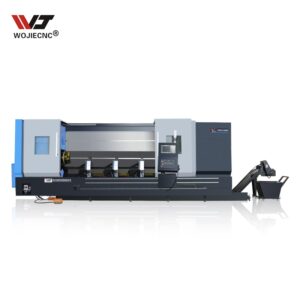
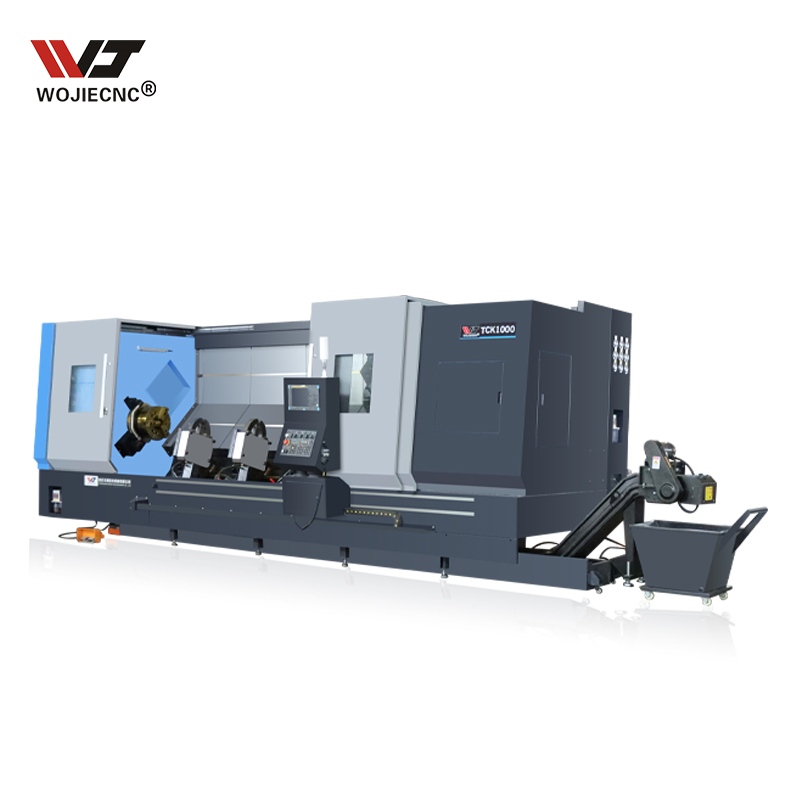
Wojie CNC (Zaozhuang Wojie CNC Machinery Co., Ltd.) builds slant bed lathes across two model families, which makes the range easier to navigate than a single long list:
- TCK series — the core slant bed line, spanning smaller bar-work machines through to heavy-duty models with large spindle bores and hydraulic chucks. Configurations include 2-axis turning as well as mill-turn variants with live tooling and Y-axis.
- WJ series — production-oriented platforms, including twin-spindle configurations and machines set up with gantry loaders for unattended running.
Common specification choices across the range include HT300-grade cast iron beds with resin-sand casting, 30°/45° slant configurations, imported linear roller guideways, and control systems from Fanuc, Siemens, Syntec, GSK or KND depending on the market and budget. The company holds ISO 9001 and CE certification, and offers OEM/ODM plus colour, function and configuration customization — which matters if you need a machine matched to an existing production cell rather than a catalogue unit.
Because the range spans bar work, twin-spindle production and mill-turn, the useful first conversation is not “what is the price” but “here is my part, my batch size and my tolerance” — that is what determines which family and which angle you should be quoted.
FAQ
1. Is a slant bed lathe always more accurate than a flat bed lathe? No. Accuracy depends on the casting, guideways, spindle and thermal compensation, not on the angle alone. A well-built flat bed lathe will out-hold a badly built slant bed. The slant bed’s advantage is structural: better chip evacuation, more mass per footprint and consistent thermal growth along one plane — which makes accuracy easier to maintain in production.
2. How can I tell a true slant bed from a flying wedge design? Ask for the bed casting drawing or a photograph of the raw casting. If the slant is part of the casting, it is a true slant bed. If the bed is flat and a wedge is bolted to the cross slide, it is a flying wedge. Supplying that image should take a manufacturer minutes — treat delay as an answer.
3. Which slant angle is best for my parts? 45° is the mainstream choice and the safe default for mixed production. Move toward 30° for larger or heavier parts where operator access matters, and toward 60° for small, high-volume parts where chip control dominates. Decide from your part family, not from a brochure.
4. Does a slant bed lathe work with a bar feeder or robot? Yes — it is the preferred platform. The inclined bed keeps chips away from the loading zone and the working envelope stays clear, which is why slant beds dominate automated turning cells.
5. What is ISO 13041 and why should I ask for it? ISO 13041 is the series of test conditions for numerically controlled turning machines and turning centres. Asking for acceptance data against it separates suppliers who test systematically from those who test by ear. Pair it with a run-off test on your actual serial number.
6. Can I get a slant bed lathe customized for my production line? Yes. Common customization tracks are colour, OEM/ODM, functional modules, and core configuration such as spindle, turret, tooling interface and CNC system. Confirm you are speaking to an engineer before committing, and ask for the configuration in writing as part of the quotation.
7. What should I check first when the machine is installed? Levelling and alignment, then a first-part cut against your drawing tolerance, then thermal stability over a sustained run — measure the same feature at the start and end of a multi-hour cycle. Record all three in the commissioning report; that record is what makes later warranty conversations factual.
Summary: The Five Checks
- Confirm the slant is cast into the bed, not bolted on — request the casting drawing.
- Match the angle to the part family — 45° default, 30° for heavy/awkward parts, 60° for small high-volume work.
- Specify the casting grade and guideway type by name, not by adjective.
- Require ISO 13041 acceptance data plus a run-off test on your serial number.
- Confirm CE compliance against the 20 January 2027 deadline and contract the commissioning report.
A slant bed lathe is a 10–15 year asset. The ten minutes you spend confirming the casting is the highest-return ten minutes in the entire purchase.