A vertical lathe is not a bigger horizontal lathe. It is a machine where gravity holds the workpiece instead of fighting it.
On a horizontal lathe, a large disc hangs off the chuck: most of its mass is cantilevered, and the jaws have to resist the part’s own weight before they resist the cutting force. On a vertical machine the part lies flat on a horizontal faceplate, so its weight seats it against the workholding. Clamping only has to handle cutting force and torque.
That single change decides four things: the maximum diameter you can turn economically, how the part is loaded, how much floor space and building height you need, and where the accuracy actually comes from.
The rule of thumb: if the part’s diameter dominates its length, the question is not “how big a lathe” — it is “which way should gravity act”.
What “Vertical” Actually Changes
The spindle axis is vertical. The chuck becomes a horizontal table facing up, and the tool comes down from a rail above it. The workpiece sits on the table rather than being held out on the end of a spindle.
That geometry has three consequences that matter more than any specification line.
1. The part is supported, not suspended. A brake drum 500 mm across and 150 mm thick is a disc. Clamp it on a horizontal chuck and roughly the whole mass sits outboard of the jaws, generating a bending moment at the jaw face and a deflection that grows with diameter. Turn it on a vertical table and the mass presses down into the clamping plane. The part is stiffer in the setup, not because the machine is stiffer, but because the load path is shorter.
2. Diameter stops driving machine size. On a horizontal lathe, maximum swing is set by the bed and the gap. Turning a 900 mm disc means a machine built around a 900 mm swing — a large, heavy, expensive horizontal. A vertical machine reaches the same diameter with a much smaller footprint, because there is no bed to swing over. This is why vertical machines dominate large-diameter, short-length work: brake drums, clutch housings, flywheel housings, flanges, rings.
3. Loading becomes a crane question. A horizontal chuck presents its jaws at roughly chest height with the part hanging in front of you. A vertical table presents a flat surface at roughly the same height with the part sitting on it. Both need a hoist once the part passes manual handling limits — but the vertical machine needs clear headroom above the table, and that is a building constraint, not a machine constraint. Buyers discover this after the machine arrives.
BLIN CNC puts the principle plainly: because the table faces up, the weight of the workpiece presses into the workholding system instead of hanging from it, which is exactly why heavy and large-diameter parts are natural candidates for this design.
The Three-Question Test: VTC or Horizontal?
Answer these before you look at a catalogue.
| Question | Points to vertical | Points to horizontal |
|---|---|---|
| Is the diameter greater than the length? | Yes — disc, drum, ring, flange, housing | No — shaft, spindle, axle, tube |
| Does the part need a tailstock for support? | No | Yes — long parts deflect without one |
| Is the part heavy enough that jaw grip is a concern? | Yes — weight helps the setup | No — weight is carried by the chuck |
Two out of three pointing vertical is a strong signal. One is not — a large flange with a long hub, for example, can be worse on a vertical machine because the hub needs support the table cannot give.
There is a fourth question that belongs in the same conversation but is usually asked last: how will you load it? If the answer is “with the overhead crane”, confirm the crane’s hook height and capacity reach the table centre before the machine is ordered.
What Vertical Buys You — and What It Costs
No machine is free. This is the honest trade.
| What you gain | What you pay | |
|---|---|---|
| Setup rigidity | Gravity assists clamping; large discs sit stiffer | Taller setup; part may need shimming on a worn table |
| Floor space | Smaller footprint for the same diameter | Needs headroom for loading and for the column |
| Chip control | Chips fall away from the cutting zone by gravity | Fines and coolant collect on the table and in the guard; cleaning access matters |
| Loading | Part locates flat and positively | Crane or hoist is mandatory; manual loading is limited |
| Speed | Large-diameter work at low rpm suits the configuration | Spindle speeds are low by design; not a machine for small parts at high rpm |
| Tooling | Short, stiff tool overhang from the rail | Boring bars and face tooling are purpose-specific; less interchangeable with horizontal tooling |
The chip point is worth more attention than it usually gets. On a vertical machine, chips fall onto the table surface around the part. If the coolant and chip guard is poorly designed, you spend the shift clearing an area the operator cannot easily reach. Ask for a photograph of the chip guard and the coolant return path on the actual model, not a rendering.
Reading a VTC Spec Sheet: A Worked Example
Take the VTC 900 as a concrete case, because abstract spec sheets are where buyers get lost.
| Spec | Value | What it actually means |
|---|---|---|
| Max rotation diameter | 1,000 mm | Physical clearance — the largest disc that will spin without hitting the guard |
| Max turning diameter | 900 mm | What the tool can actually reach. This is the number to design around, not the 1,000 |
| Tool holder vertical travel | 700 mm | How tall a part you can face and bore in one setup |
| Tool holder horizontal travel | 650 mm | Radial reach from the table centre outward |
| Spindle | A2-11, 20–600 rpm, 22 kW | Low-speed, high-torque configuration — correct for large discs, wrong for small parts |
| Hydraulic chuck | 630 mm | Sets the practical workholding envelope; larger parts need a faceplate and fixtures |
| Positioning accuracy | ±0.008 mm | Only meaningful with the test standard named — see below |
| Machine weight | ≈7,500 kg | Foundation and floor-loading input, not a spec-sheet curiosity |
Two lessons sit in that table.
First, the clearance figure is not the capacity figure. A 1,000 mm rotation diameter against a 900 mm turning diameter means a 50 mm radial margin on each side. A part that measures 950 mm will spin, and you will not be able to turn its outer edge. Buyers routinely quote the larger number to themselves.
Second, “positioning accuracy ±0.008 mm” is not a quality claim on its own. It becomes one when attached to a named acceptance standard and a measured test report on your serial number. Which brings us to verification.
The relevant standard family for this machine type is ISO 3655, Acceptance conditions for vertical turning and boring lathes with one or two columns and a single fixed or movable table — it specifies both geometrical and practical tests and the corresponding permissible deviations (ISO). Ask which tests were run and see the recorded values.
The Costs That Never Appear in the Quote
Four items, all of which land on your side of the ledger:
- Crane coverage. Hook height, capacity at radius, and whether the hook can reach the table centre. A machine that fits the floor but not the crane is a machine you cannot load.
- Foundation and floor loading. A machine of this class concentrates load under the base and the column. Confirm the slab specification before delivery, not after.
- Tooling that is not interchangeable. Boring bars, face mills and chamfer tools sized for a vertical rail do not migrate from your horizontal lathes. Budget the first tooling package with the machine.
- Chip and coolant handling. Confirm the guard design and the coolant tank access on the model you are buying.
None of these are exotic. All of them are routinely discovered in the week the machine arrives.
What to Verify Before You Sign
Five checks, in order:
- Faceplate runout and table flatness — recorded, on your serial number, not a generic certificate.
- ISO 3655 test values — geometrical and practical, with the deviations stated.
- Clamping force and jaw stroke at the hydraulic pressure you will actually run.
- Z-axis counterbalance — a vertical machine carries the rail against gravity; confirm the counterbalance arrangement and that it is set for your tooling weight.
- CE documentation where the machine ships to the EU, built against the regime in force at completion — Regulation (EU) 2023/1230 becomes mandatory on 20 January 2027, replacing Directive 2006/42/EC (EUR-Lex).
For a machine completing around that date, the question is which regime the technical file is built against. A supplier who cannot answer that is telling you something about their document control.
Where Wojie’s VTC Range Fits
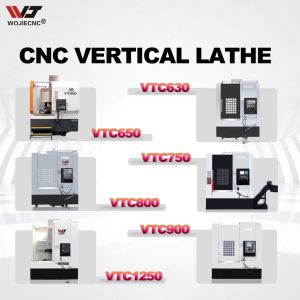
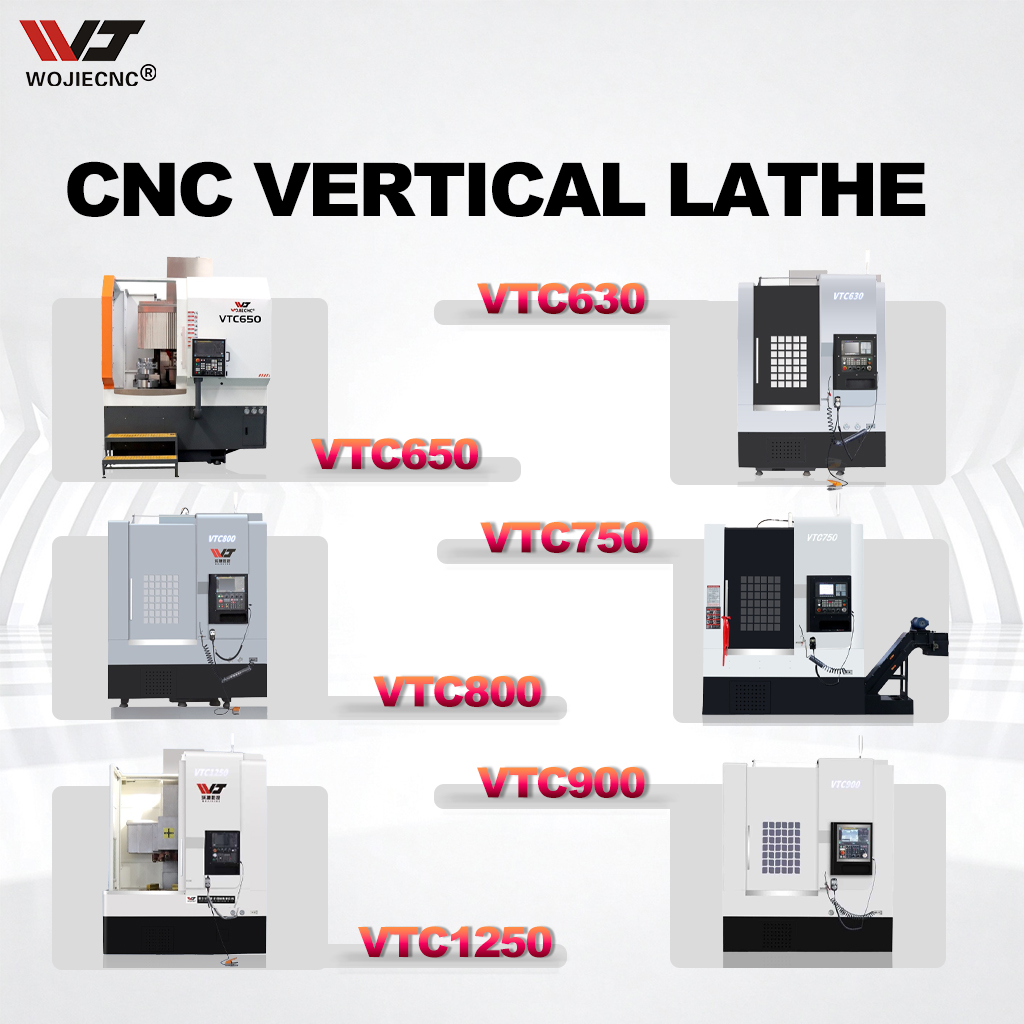
Wojie CNC builds the VTC series alongside its slant-bed and flat-bed lathes, on six production bases, with ISO 9001 and CE certification and OEM/ODM configuration. The VTC 900 is a single-column vertical machine aimed squarely at the parts this article has been describing — brake drums, clutch shoes and flywheel housings — with resin-sand castings that are heat-aged and vibration-treated to settle residual stress before machining, and a Z-axis counterweight to carry the rail.
That casting treatment is the detail worth asking about on any vertical machine. A column and base that move after assembly destroy geometric accuracy faster than any control-system difference, and the fix is in the foundry, not in the software.
FAQ
1. What is a vertical lathe used for? Large-diameter, short-length parts: brake drums, clutch housings, flywheel housings, flanges, rings and discs. The configuration suits parts where the diameter dominates the length and where the weight would otherwise hang from a chuck.
2. Is a vertical lathe more accurate than a horizontal lathe? Not inherently. It is stiffer in the setup for disc-shaped parts, because gravity seats the workpiece instead of cantilevering it. For long shafts, a horizontal lathe with a tailstock is the more accurate choice — the vertical machine has no way to support the free end.
3. What is the difference between a vertical lathe and a VTL? VTL stands for vertical turning lathe, and the terms are used interchangeably with VTC (vertical turning centre). “Centre” usually implies CNC control and an automatic tool turret rather than a manual machine.
4. Can a vertical lathe turn a part taller than it is wide? It can, within the tool-holder vertical travel — 700 mm on the VTC 900. But as the length grows, the advantage of the vertical configuration shrinks and the lack of tailstock support becomes the limiting factor.
5. Why is the spindle speed so low on a vertical lathe? Because the workholding is sized for large diameters. At 600 rpm a 900 mm part already develops very high surface speed at the rim. Low rpm with high torque is the correct configuration for this class of work, not a limitation to be engineered around.
6. Do I need a crane to operate a vertical lathe? For any part above manual handling limits, yes — and the crane must reach the table centre at sufficient hook height. This is the most common pre-purchase oversight on vertical machines.
7. What standard covers vertical lathe accuracy? ISO 3655, Acceptance conditions for vertical turning and boring lathes with one or two columns and a single fixed or movable table. Ask for the recorded test values on your machine’s serial number.
Summary
- Vertical is a fixturing decision. Gravity seats the part instead of fighting it.
- Diameter dominant, length short — that is the vertical case. Long parts still belong on a horizontal machine with a tailstock.
- Design around the turning diameter, not the rotation clearance.
- Budget the crane, the foundation, the tooling and the chip handling before you compare machine prices.
- Ask for ISO 3655 values on your serial number, and for the CE file built to the regulation in force at completion.
The buyers who regret a vertical machine almost never regret the machine. They regret the crane they did not measure, or the clearance figure they mistook for capacity.