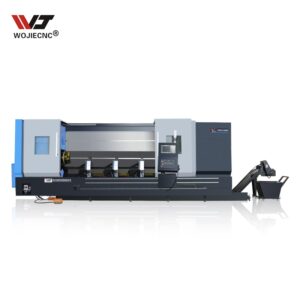
In the field of high-end equipment manufacturing, precision is the core indicator for measuring machine tool performance. For vertical lathes responsible for complex rotational part processing, achieving ±0.01mm-level precision requires not only breaking through the limitations of traditional mechanical structures but also making technological innovations in key areas such as intelligent control and thermal stability. This article takes the turret CNC vertical lathe as the research object, analyzes the three major technical breakthroughs to achieve millimeter-level precision, and reveals the technological evolution path of modern machine tool manufacturing combined with practical applications in aerospace, new energy vehicles, and other fields.
I. Mechanical Structure Revolution: Evolution from Rigid Foundation to Dynamic Equilibrium
1. Application of Meehanite Cast Iron Bed
Traditional machine tools mostly use common cast iron or welded structures, while high-end turret vertical lathes generally adopt Meehanite cast iron, with a density of 7.35g/cm³ and a bending strength 25% higher than that of common cast iron. Through resin sand molding process, the bed forms a uniform metallographic structure inside. Combined with finite element analysis to optimize the rib structure, the static stiffness in the X/Y axis direction can be increased to 180N/μm (industry average is about 120N/μm).Case: A aviation engine enterprise uses a Meehanite bed vertical lathe to process titanium alloy turbine discs. At a high-speed cutting of 800rpm, the surface roughness Ra value is stably below 0.8μm, which is 50% higher than that of traditional machine tools.
2. Integrated Design of Electric Spindle and Turret
The 12-station power turret of the turret vertical lathe is driven by a direct-drive servo motor, reducing the tool change time to 0.8 seconds (traditional hydraulic turret takes more than 3 seconds). Combined with a static pressure electric spindle (maximum speed 8000rpm, radial runout ≤0.001mm), it realizes composite processing of “turning + milling + drilling”. In the processing of new energy vehicle motor housings, the single-process completion time is reduced by 40% compared with traditional machine tools, and the dimensional consistency reaches ±0.01mm.
II. Control Algorithm Revolution: Construction of Full Closed-Loop Compensation System
1. Real-Time Calibration by Dual-Frequency Laser Interferometer
By installing a RENISHAW XL-80 dual-frequency laser interferometer on the X/Z axis, a full closed-loop feedback system is established. This system not only compensates for the pitch error of the ball screw (up to ±0.002mm/m) but also dynamically corrects thermal deformation. When the spindle temperature rise exceeds 15℃, the CNC system automatically triggers the thermal error compensation algorithm, and the X-axis compensation amount can reach 0.015mm (traditional semi-closed-loop system does not have this function).Data Comparison:
Error Type | Traditional Machine Tool | Full Closed-Loop Lathe |
Positioning Accuracy | ±0.02mm | ±0.008mm |
Repeat Positioning Accuracy | ±0.015mm | ±0.003mm |
Thermal Deformation Influence | 0.05mm/℃ | 0.005mm/℃ |
2. AI-Driven Adaptive Control
Deep learning algorithms are introduced to process sensor data. When the cutting force exceeds the threshold (such as titanium alloy processing exceeding 800N/mm²), the system automatically adjusts the spindle speed and feed rate. When a military enterprise processes integral blisks, this technology extends the tool life from 2 hours to 5 hours and reduces the scrap rate by 60%.
III. Process Integration Revolution: From Single Processing to Full-Process Precision Control
1. Five-Surface Machining in One Clamping
The turret vertical lathe is equipped with a 90° power milling head to achieve “turning-milling composite” five-surface machining. In the processing of aviation gearboxes, the traditional process requires 3 clampings, with a cumulative error of ±0.03mm. The one-clamping solution uses the HSK-A63 tool system (radial positioning accuracy ±0.001mm) to control the overall error within ±0.01mm, reducing processing time by 50%.
2. Digital Twin Pre-Verification
A digital twin of the machine tool is constructed through VERICUT software to simulate tool paths and interference risks in advance. When a new energy vehicle enterprise developed an 800V high-voltage motor shaft, digital twin reduced programming errors to zero, and the first-piece pass rate increased from 65% to 98%.
Application Scenarios and Industrial Value
Industry Field | Machining Object | Precision Requirement | Turret Lathe Advantages |
Aerospace | Titanium Alloy Integral Blisk | Profile Accuracy ±0.02mm | 5-axis simultaneous + Thermal Compensation, One-Time Forming |
New Energy Vehicles | Motor Housing/Planetary Gear | Coaxiality ±0.01mm | Power Turret + Full Closed-Loop, Multi-Process Integration |
Precision Instruments | Optical Lens Base | Surface Roughness Ra0.4 | High-Precision Electric Spindle, Mirror Finish Machining |
In the context of accelerated domestic substitution, turret CNC vertical lathes are breaking through import monopolies. For example, the Code NC KVC650M turret vertical lathe, equipped with the self-developed GNC62 full-digital system, successfully replaced German DMG Mori’s similar equipment in a aerospace enterprise, reducing costs by 40% and improving maintenance response speed by 3 times.
Conclusion: The Technical Philosophy Behind Precision
The precision revolution of turret CNC vertical lathes is essentially a deep integration of “mechanical rigidity + digital flexibility”. From the molecular-level structure optimization of Meehanite cast iron to the nanometer-level error compensation of AI algorithms, each technical breakthrough points to the same goal: using deterministic engineering methods to cope with the uncertainties in the processing process. For manufacturing enterprises, choosing such equipment is not just purchasing a machine but acquiring a complete set of precision control solutions.
Contact us now to learn how to improve your precision machining capabilities through turret CNC vertical lathes and unlock the productivity revolution behind millimeter-level precision.