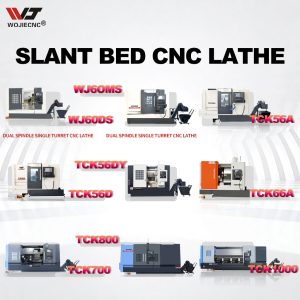
CNC Lathe Price: What the Quote Actually Pays For

A CNC lathe does not have a price. A configuration has a price. The model number sets the envelope — swing, centre distance, spindle bore — and everything that actually moves the number sits underneath it.
Four items explain most of the gap between two quotes for machines of the same size:
- The bed casting — grade of iron, whether it is resin sand, and how residual stress is relieved.
- The guideways — linear roller rails versus box ways, and the rail width.
- The spindle — bore, bearing grade and arrangement, motor and drive.
- The turret and control — BMT versus VDI tooling interface, station count, and which CNC platform.
A fifth item explains the rest: what is not in the quote. Tooling, commissioning, training, spares, freight and warranty terms move the real cost more than most buyers expect, and they are the easiest things to leave out of a comparison.
The Line Items That Explain Most of the Gap
1. Bed casting — the item you cannot retrofit
Grade of cast iron, casting method and stress relief decide whether the machine holds geometry after two years of heavy cutting. Resin sand casting with heat ageing and vibration treatment costs more than green sand without treatment, and the difference is invisible in a specification table.
It is also the only item on this list that cannot be upgraded later. A control system can be swapped. A bed cannot.
2. Guideways — linear versus box
Linear roller guideways give higher rapid traverse and lower friction. Box ways give higher load capacity and better damping on heavy interrupted cuts. Neither is universally better; the price difference comes from rail width, preload class and brand.
A 55 mm rail and a 45 mm rail look identical in a brochure photo. They are not the same machine.
3. Spindle — bore, bearings, drive
Spindle bore determines bar capacity and therefore what the machine can be used for. Bearing grade and arrangement determine speed, rigidity and thermal behaviour. A2-11 with a 140 mm through hole is a different class of casting and bearing set from A2-6 with 65 mm.
The spindle is where “same size, half the price” usually originates.
4. Turret and tooling interface
BMT turrets carry driven tools with better rigidity than VDI in most configurations, and cost more. Station count, tool section and whether the turret has a Y-axis all change the number.
5. Control system
Fanuc and Siemens carry a premium over GSK and KND. The premium buys service network depth, programming familiarity in your market, and resale value — not necessarily accuracy.
6. Chuck, tailstock and automation
A hydraulic chuck, an automatic tailstock and a chip conveyor are frequently listed as “options”. They are not optional in practice for production work, and they should be priced in from the start.
One Real Price, Read Carefully
The TCK1000 is listed at USD 96,000 on the CNC lathe category page. That is a useful anchor precisely because the specification behind it is published:
| Item | Value |
|---|---|
| Spindle | 22 kW, 5–1600 rpm, A2-11, φ140 mm through hole, φ115 mm bar capacity |
| Capacity | φ950 mm max turning diameter, 2300 mm max turning length, φ1000 mm swing over bed |
| Bed | HT300 resin sand integral casting, 45° slant |
| Guideways | 55 mm X/Z rails, X stroke 510 mm, Z stroke 2500 mm, rapid 18 m/min |
| Turret | BMT65 SH 20-12, Y-axis electric turret ±70 mm, tool section 25×25/40 mm |
| Accuracy | Repeat positioning X ±0.003 mm, Z ±0.01 mm; IT6–IT7; Ra ≤1.6 μm on non-ferrous |
| Mass | 11,000 kg |
Three things this teaches about price:
The number is a configuration, not a model. Change the control to Siemens, add a chip conveyor and a hydraulic chuck, and the figure moves. Any comparison that ignores the option list is comparing two different machines.
Mass is a price signal. An 11,000 kg machine and a 6,000 kg machine of similar capacity do not contain the same amount of iron. Casting mass is one of the few honest proxies for rigidity available before you cut metal.
Accuracy claims still need a standard. “Repeat positioning ±0.003 mm” is only comparable when the measurement method is named — ISO 13041-1 covers geometric tests for horizontal-spindle turning machines, and the positioning method comes from ISO 230-2 (ISO 13041-1). Without that, the number is a claim, not a specification.
Why Two Quotes for “the Same Lathe” Differ
Three mechanisms, all common:
Different envelopes. One quote is for 500 mm turning length, the other for 1000 mm. The bed, ballscrew, guideway and tailstock all scale with length. Buyers compare the headline price and miss the stroke difference.
Different inclusions. One quote is FOB with no tooling and no commissioning. The other is CIF with a tooling package and a technician visit. The second looks materially more expensive and may be the cheaper machine.
Different component grades. Same model name, different bearing brand, different rail width, different control. This is where most of the gap usually comes from — and it is invisible unless you ask for the component list in writing.
The Normalised RFQ: Twelve Lines That Make Quotes Comparable
Send this to every supplier, on the same drawing, and the quotes become comparable.
| # | Line item | Why it must be specified |
|---|---|---|
| 1 | Max turning diameter and length | Sets the envelope; everything else scales from it |
| 2 | Spindle bore / bar capacity | Determines what work the machine can take |
| 3 | Spindle motor power and speed range | Roughing capability and thermal behaviour |
| 4 | Bed material, casting method, stress relief | Cannot be retrofitted; drives long-term geometry |
| 5 | Guideway type and rail width | Rigidity versus speed trade-off |
| 6 | Turret type, station count, tool section | Tooling cost and cycle time |
| 7 | Control system and version | Service, training, resale |
| 8 | Chuck type and size | Workholding cost, often excluded |
| 9 | Accuracy values with test standard | Makes accuracy comparable |
| 10 | Inclusions: tooling, commissioning, training, spares | The real differentiator |
| 11 | Incoterm and port | Landed cost, not unit price |
| 12 | Warranty terms and response time | The cost of being down |
If a supplier will not answer lines 4, 6 and 10 in writing, the quote is not a quote — it is an opening position.
Where the Cheap Quote Hides
Seven places, in rough order of how much they cost you later:
- Untreated castings. No heat ageing, no vibration treatment. Geometry moves in the first year.
- Narrower guideways than the class of machine implies.
- Lower bearing grade in the spindle — invisible until you run at speed for six hours.
- VDI instead of BMT where the part mix needs driven tools.
- A control system with no local service in your country.
- “Optional” chuck, tailstock and conveyor that you will buy anyway, at a worse price, later.
- No commissioning — the machine arrives, and the first cut is your problem.
None of these appear as a line item called “savings”. They appear as a lower total, and then as downtime.
Total Cost, Not Purchase Price
The CNC lathe price you sign is roughly half the decision. The other half:
| Cost | Typical form | Why buyers miss it |
|---|---|---|
| Tooling package | A separate budget line, not a rounding error | Often quoted separately, after the decision |
| Freight and insurance | Depends on Incoterm | FOB quotes look cheaper and are not landed cost |
| Import duty and clearance | Destination-specific | Not in any supplier quote |
| Foundation and installation | Civil work, levelling | Discovered after delivery |
| Commissioning and training | Days of technician time | Frequently “included” verbally, not in writing |
| Spares and consumables | First-year stock | Rarely budgeted |
| Downtime risk | Unplanned | The largest number, and the only one nobody quotes |
A machine that costs 10% more and arrives commissioned, with local service and a spares stock, is usually the cheaper machine by the second year.
Where Wojie Fits
Wojie CNC builds slant-bed and flat-bed lathes, vertical lathes and vertical machining centres across six production bases, holds ISO 9001 and CE certification, and offers OEM/ODM configuration.
On price specifically, the useful thing is not a headline number — it is that the specification behind a listed price is published. The TCK1000’s casting grade, rail width, turret model, spindle bore and accuracy values are all on the product page, which means a buyer can normalise it against another quote line by line instead of comparing two totals.
That is the only basis on which a price comparison means anything.
FAQ
1. How much does a CNC lathe cost? It depends on the envelope and configuration, not the model name. A small flat-bed lathe and a heavy slant-bed machine with a 140 mm spindle bore are in different categories entirely. Ask for a price against a written specification, not a model number.
2. Why is one quote 30% cheaper than another for the same size? Usually component grade: casting treatment, rail width, spindle bearing class, turret type, control brand — plus what is excluded from the quote. Ask for the component list and the inclusion list in writing.
3. Is a cheaper control system a false economy? Not always. GSK and KND are workable platforms. The real question is local service depth and whether your operators and programmers know the system. A premium control with no local support is worse than a standard control with good support.
4. Should I buy FOB or CIF? Compare landed cost. FOB gives you control over freight and insurance but shifts logistics risk to you. CIF is simpler but hides the freight margin inside the price.
5. What should be included in the quotation? Tooling, commissioning, operator training, a first-year spares list, warranty terms and response time. If these are not written down, they are not included.
6. Does machine weight really matter? It is one of the few pre-purchase proxies for rigidity. Two machines of similar capacity with very different masses do not contain the same amount of casting, and casting is what damps vibration.
7. How do I compare accuracy claims between suppliers? Ask for the value, the axis, the direction and the test standard — ISO 13041-1 for geometry, ISO 230-2 for positioning. A number without a method is marketing.
Summary
- A CNC lathe price belongs to a configuration, not a model number.
- Four items move it most: casting, guideways, spindle, turret and control.
- The fifth is what the quote excludes — tooling, commissioning, freight, spares.
- Normalise with a twelve-line RFQ, on one drawing, for every supplier.
- Compare landed cost and total cost, not the unit price on the first page.
The most expensive machine in a shortlist is rarely the one with the highest price. It is the one whose missing items you discover in the first month of production.