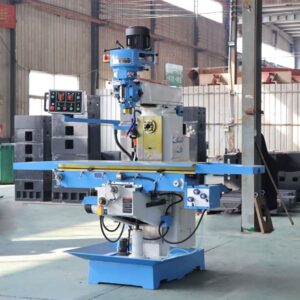
CNC Machining Center: The Quiet Brain Behind Modern Manufacturing
Walk into a modern factory and you might hear the hum before you see the machine. No sparks flying, no shouting operators, no chaos—just a steady rhythm of motion. At the center of that calm precision sits one of the most influential inventions in industrial history: the CNC Machining Center.
It doesn’t demand attention. It doesn’t show off. Yet nearly everything you touch—your phone, your car, your watch, even medical implants—owes its existence to this machine’s silent intelligence.
More Than a Machine, Less Than a Human—Exactly What Industry Needed
A CNC Machining Center is not just a tool; it’s a decision-making system wrapped in steel.
“CNC” stands for Computer Numerical Control, but that phrase barely captures its role. Think of it as a translator between human intent and physical reality. Engineers speak in digital instructions—coordinates, tool paths, speeds—and the CNC machining center converts those abstract commands into micrometer-perfect motion.
Unlike manual machines that rely on human hands and judgment, CNC machining centers rely on repeatable logic. Once programmed, they do not forget, tire, or improvise. That reliability is their superpower.
Precision as a Philosophy
In a CNC machining center, precision isn’t a goal—it’s a baseline.
Every movement happens along calculated axes, often three, five, or more, coordinated simultaneously. Cutting tools approach raw material with confidence measured in thousandths of a millimeter. The result is not just accuracy, but predictability—a part made today will be indistinguishable from one made six months later.
This is why aerospace components fit together at 30,000 feet, why surgical tools work inside the human body, and why engines can run for millions of cycles without failure.
Precision here isn’t flashy. It’s disciplined.
The Machining Center as a Multitasker
What separates a machining center from simpler CNC machines is integration.
A single CNC machining center can:
Mill flat surfaces
Drill deep, straight holes
Tap threads
Bore complex cavities
Change tools automatically in seconds
All without human interruption.
Tool changers rotate like a well-trained pit crew. Pallet systems swap workpieces. Sensors check tool wear, temperature, and alignment. The machining center becomes a compact production ecosystem—less like a single machine and more like a mini factory with one mind.
Digital Craftsmanship in a Physical World
There’s a quiet irony in CNC machining: the more digital it becomes, the more it revives craftsmanship.
Before CNC, complex parts required master machinists with years of experience. Now, that expertise is captured in code—G-codes, CAM software strategies, and simulation models. The craftsmanship hasn’t disappeared; it’s been encoded.
Modern machinists are part engineer, part programmer, part strategist. They don’t just cut metal—they design how metal should be cut. Tool paths are optimized like chess moves, balancing speed, tool life, surface finish, and cost.
The machining center executes this strategy flawlessly, every time.
Why CNC Machining Centers Matter More Than Ever
In a world obsessed with speed and scale, CNC machining centers offer something rare: controlled flexibility.
Need one prototype? Done.
Need ten thousand identical parts? Done.
Need to switch designs overnight? Load a new program.
They thrive in high-mix, low-volume production just as comfortably as in mass manufacturing. This adaptability makes them essential in industries facing rapid innovation cycles—electric vehicles, renewable energy, robotics, and medical technology.
They don’t just support innovation; they enable it.
Automation Without Anonymity
Despite their automation, CNC machining centers don’t erase human involvement. They sharpen it.
Humans decide:
The design intent
The machining strategy
The materials
The tolerances that truly matter
The machine handles the repetition, the endurance, and the microscopic accuracy. It’s a partnership—humans define what matters, machines ensure it happens consistently.
This balance is why CNC machining centers feel less like job stealers and more like capability amplifiers.
The Future: Smarter, Quieter, More Autonomous
The next generation of CNC machining centers is already evolving:
AI-assisted tool path optimization
Real-time adaptive machining
Predictive maintenance
Lights-out manufacturing
Soon, these machines won’t just follow instructions—they’ll adjust them. They’ll learn from past jobs, detect inefficiencies, and refine their own processes.
Not loud. Not dramatic. Just smarter.
Final Thought: The Invisible Backbone of Progress
CNC machining centers rarely make headlines. You won’t see them trending online. But without them, modern civilization would stall almost instantly.
They are the invisible backbone of progress—machines that turn ideas into objects, designs into realities, and digital dreams into solid form.
In the end, the CNC machining center isn’t about metal, speed, or code.